Product Category Overview
This category reference describes documented ESD accessories product types, comparison fields, manufacturer references, and source-linked model records. It is a product-category reference; the related Technology & Applications and Product Guides pages address control principles and step-by-step selection, installation, maintenance, measurement, or verification methods.
Source checked: August 2026.
What Are ESD Accessories?
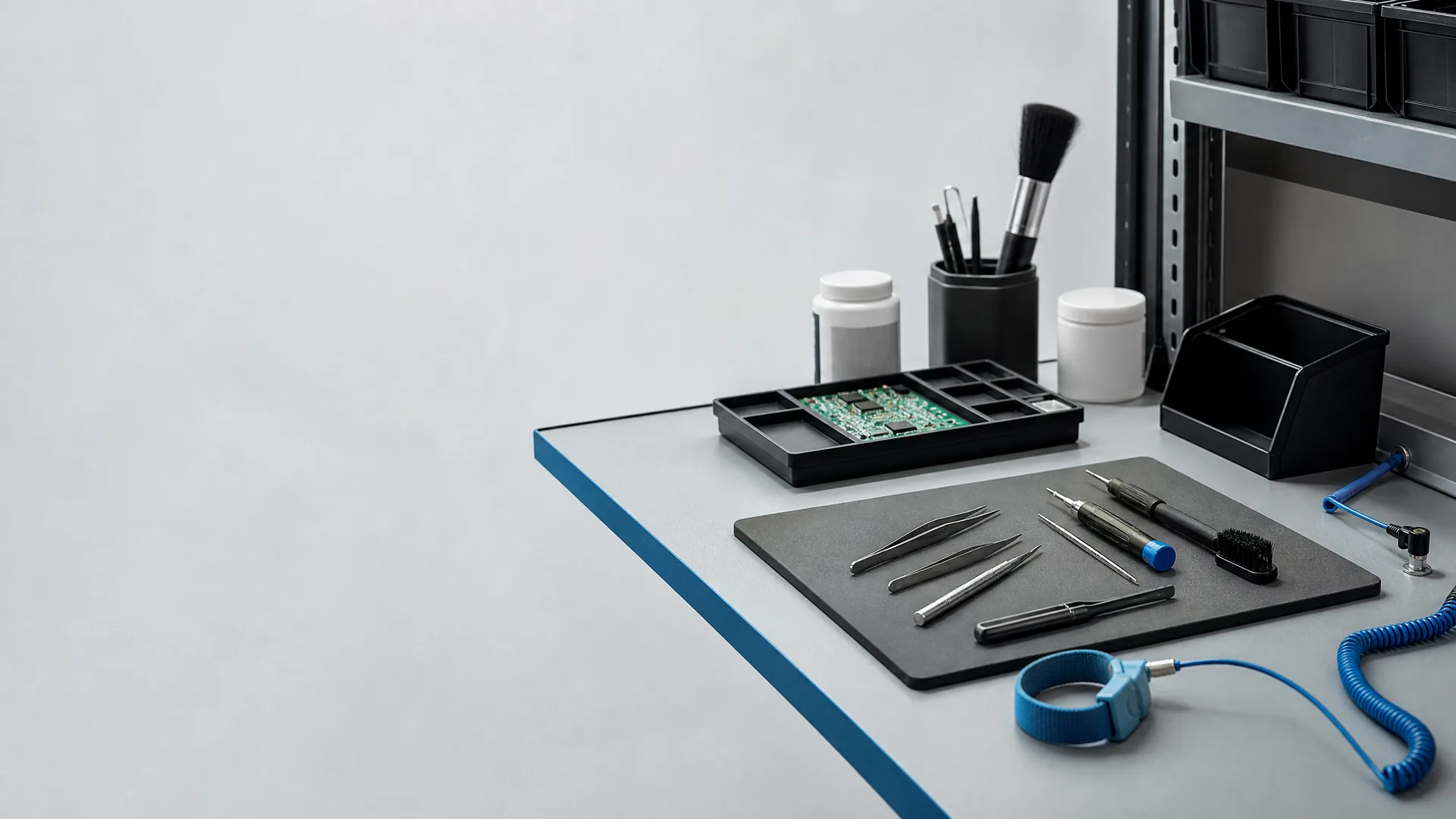
ESD accessories are supporting items used around a defined static-control process. Depending on the task, the category may include conductive or dissipative brushes, finger cots, labels and signs, ground snaps and related connection hardware, handling aids, or other ancillary tools. Their engineering value comes from the role they perform within the larger control arrangement—not from the assumption that any accessory independently provides complete ESD protection. 1
An accessory should be selected from the actual handling activity, material interaction, work surface, grounding arrangement, ESD-sensitive item exposure, cleanliness requirement, and verification program. Accessories may support a core control, but they do not replace grounding, personnel controls, work surfaces, packaging, material selection, or ionization where those controls are required. 1
Documented Application Contexts
| Work condition | Category role | Engineering question |
|---|---|---|
| PCB or component cleaning | Remove dust, debris or residues using an accessory with suitable static-control material behavior. | Does the brush/material form support the handling and contamination-control task without introducing a new charge source? |
| Delicate component handling | Provide a controlled contact interface through finger cots, gloves or handling aids. | Is the accessory material appropriate for the device, handling task and applicable evaluation method? |
| Workstation organization | Identify ESD-protected locations, connect components, or support consistent handling practice. | Does the sign, snap, connection item or aid match the established workstation control arrangement? |
| Temporary process support | Support defined cleaning, repair, inspection or packaging activity. | Does the accessory complement the core control rather than substitute for it? |
Static Control in Electronics and PCB Assembly provides the process context. Grounding Tests and ESD Control Verification covers the verification context, and Grounding and ESD Questions and Answers provides reader-facing program context.
Product Types
1. Functional Accessory Form
| Product type | Category role | Typical use context | Database fields to record |
|---|---|---|---|
| Conductive or dissipative brush | Supports cleaning or removal of particles/debris with a documented brush material behavior. | PCB, component, fixture, work-surface or controlled cleaning task. | Brush material class, bristle/handle form, electrical-property field, size/form and cleaning use context. |
| Finger cot or handling interface | Provides a localized handling barrier with stated material behavior. | Component handling, inspection, clean handling or short-duration manual operation. | Material form, electrical-property/test field, size/fit, powder/contamination field and replacement context. |
| Grounding connection accessory | Supports a documented connection between an ESD-control item and the control arrangement. | Worksurface, mat, fixture, cord, ground point or equipment-support integration. | Connection form, mating hardware, path role, marking and test/inspection field. |
| Identification and process accessory | Supports visual identification, controlled workflow or defined handling practice. | EPA boundaries, workstations, storage, transport or process locations. | Symbol/label type, application location, material/process compatibility and replacement field. |
2. Material-Behavior Form
Accessory materials may be documented as conductive, dissipative or low charging. These terms describe material behavior under the relevant method and source conditions; they should not be used as generic marketing labels. The engineering question is whether the accessory’s material, contact pattern and process use fit the relevant static-control role.
Menda distinguishes conductive, dissipative and anti-static brush materials for different cleaning and charge-management contexts. That distinction can guide a category field, but it does not establish that one material type is suitable for every component or process. 2
Product Comparison Criteria
Compare the documented product attributes below when reviewing category records. These fields support product-to-product comparison; they do not prescribe a complete static-control method or a step-by-step selection workflow. Use the related Technology & Applications and Product Guides pages for those separate questions.
| Decision dimension | Information to define or record | Why it matters |
|---|---|---|
| Work objective | Cleaning, handling, connection, identification, packaging support, repair or inspection. | Accessory selection begins with the actual task and its static-control role. |
| Contact and material interaction | Contact pressure, surface sensitivity, particle/debris concern, material compatibility and ESD-sensitive item exposure. | An accessory may protect one aspect of a task while creating a material or contamination concern in another. |
| Electrical behavior | Documented conductive/dissipative/low-charging property, method and grounding path where applicable. | Material terminology must be interpreted in the source and installed use context. |
| Integration | Workstation location, connection hardware, storage, replacement, cleaning and user workflow. | An accessory must fit the existing control arrangement and remain manageable in use. |
| Verification | Inspection, applicable material/test method, record and corrective-action path. | An accessory should have a defined way to confirm it remains suitable for the task. |
Technical Specifications
Fields not documented in the cited source are not inferred from another model, family, or manufacturer. They remain recorded as Not documented until an applicable official source is available.
| Field group | Technical information to compare | Meaning | Record boundary |
|---|---|---|---|
| Product identity | Manufacturer, brand, model / series, accessory type | Identifies the manufacturer documentation. | Retain official source URL; do not infer availability. |
| Functional role | Cleaning, handling, connection, identification or process-support form | Defines the accessory’s intended task. | An accessory role does not establish whole-program control. |
| Physical configuration | Brush/handle/bristle form, finger-cot material/fit, connection/snap form, label or aid form | Describes the interface with the task. | Dimensions and materials are model-specific. |
| Material / electrical field | Conductive, dissipative, low-charging or stated test/property field | Describes documented material behavior. | Record source conditions; do not transfer values between accessory forms. |
| Environment and service | Cleaning, contamination, replacement, storage, process restriction and inspection field | Describes lifecycle context. | Do not infer service intervals or suitability for unlisted chemicals/processes. |
| Provenance | Official document URL, test/method note and record status | Connects a reference to evidence. | A source link is not a recommendation or certification. |
Manufacturer References
Inclusion does not constitute a ranking or recommendation. Manufacturer entries identify documented category presence and official reference material only.
| Manufacturer / brand | Category presence | Neutral reference scope | Official source |
|---|---|---|---|
| Menda | Conductive and dissipative ESD brushes | Official brush documentation supports material-behavior and brush-form reference fields. | Menda 36094 ESD Brush |
| Desco | ESD-control accessories, handling aids and related workstation supplies | Official catalog context supports neutral accessory-category reference. | Desco product catalog |
Product Model References
| Brand | Model / series | Product type | Functional reference | Documented reference fields | Record status |
|---|---|---|---|---|---|
| Menda | 36094 | Dissipative ESD brush | Brush for defined cleaning and particle/debris-removal tasks in static-sensitive contexts. | Dissipative material category, flat-handle form, nylon bristles, size/form and source-documented electrical-property context. Source | Official-source reference; suitability remains task- and material-specific. |
Comparing Product Models
| Model / series | Product type | Primary functional reference | Fields requiring model-specific review | Accessory question to verify |
|---|---|---|---|---|
| Menda 36094 | Dissipative ESD brush | Controlled brush material behavior for defined cleaning tasks. | Bristle/handle material, electrical-property statement, component compatibility, cleaning procedure and current documentation. | Does the brush material and physical form suit the component, contamination task and ESD-control arrangement? |
Reference note — This page provides product-category information, documented comparison fields, manufacturer references, and model records. It does not provide price, inventory, current availability, rankings, or purchasing recommendations. Consult the cited official documentation for current model-specific information.